

What are the key features of automatic control technology in music fountains
Automatic control technology is the core of achieving synchronous coordination of "sound, light, and water" in music fountains. Its key lies in transforming the emotions and rhythms of music into dynamic water shapes and lighting effects through precise signal processing, real-time control, and system integration.
The key technical points are as follows:
1. Core control technology
Music signal processing and feature extraction
The system performs real-time analysis on audio signals, extracting rhythm, volume, spectrum, and emotional features (such as shock, emotion, and joy) with an accuracy of up to 10 milliseconds
Common techniques include Fast Fourier Transform (FFT) and Digital Signal Processing based on DSP (such as TMS320C6713)
Intelligent voice control and synesthesia mapping
By utilizing the principle of synesthesia, auditory sensations (such as high pitch → bright, low pitch → steady) are mapped into visual control parameters (such as water column height, light color), achieving a natural fit between water shape and musical emotions
High precision synchronous control
By establishing a millisecond level timeline, ensure strict alignment of each nozzle start stop, frequency converter speed regulation, lighting changes, and music nodes, and compensate for mechanical delays
Distributed networked control architecture
Adopting industrial Ethernet or WiFi LAN to achieve flexible communication between the upper computer (PC/intelligent terminal) and the on-site controller (such as frequency converter, solenoid valve driver), supporting remote monitoring and expansion
2. Key modules of system composition
Central control section
The upper computer runs specialized control software (such as MFTPRO, Kingview), responsible for music analysis, emotion recognition, control file generation, and human-computer interaction
Supports two modes: pre control (customizing water patterns according to the track) and real-time sound control (responding to any audio source)
On site controller and actuator
PLC or DSP controller: parses instructions to drive submersible pumps, frequency converters, solenoid valves, multi-dimensional swing nozzles, etc
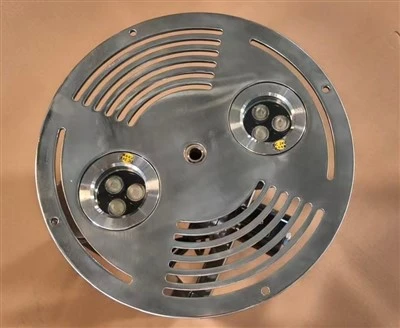
Execution equipment: including variable frequency water pump (achieving stepless speed regulation), underwater color lights (RGB color matching), multi degree of freedom nozzle (2D/3D control)
Safety and reliability mechanism
Each device is equipped with overvoltage, overcurrent, and leakage protection, and automatically shuts down in case of a fault
The key components adopt redundant design (such as dual power supply and dual CPU) to enhance system stability
3. Comparison of advanced control methods
A. Real time voice control
Advantage: Responds to any audio source (such as microphone, CD) with water lag
Weak point: Uniformity, and emotional inconsistency
B. Pre control
Advantage: Manually arrange drainage and lighting for each piece of music
Weak point: Requires a lot of preliminary work and low flexibility
C. Intelligent fully automatic control
Adbantage: Automatically identify emotional features and dynamically generate control instructions
Weak point: Complex technology, relying on high-quality algorithms
4. Typical technical implementation cases
PLC based system: Control water pump pulses through ladder diagrams or structured text (such as MIDI NoteOn triggering 500ms spray) to achieve precise rhythm synchronization
System based on Kingview: using Profibus DP bus to communicate with Siemens S7-300 PLC, supporting 5 working modes (manual, automatic, and random modes with/without music)
Modern integration solution: integrating DSP audio processing, WiFi communication, LED dyeing lights, and multi-dimensional nozzles to form an integrated intelligent landscape of "sound light water"
In summary, the key to automatic control technology in music fountains lies not only in the precise execution of hardware, but also in the software's understanding and artistic translation of music semantics, ultimately achieving a deep integration of technology and aesthetics