

Seven tips for creating a beautiful fountain
In recent years, most of the water features built in cities have been abandoned and unused, with problems such as stagnant water, non spraying fountains, black water color, and foul odor. In some residential projects, water features are more commonly used as a means of value-added and promotion, and their design and construction do not consider long-term sustainability, thus planting many hidden dangers. Replacing design goals with aesthetics is one of the reasons for the failure of water features. Let's talk about how to preserve the beauty of water features.
1. When conceptualizing water features, maintaining water quality should be the main design basis. It's simple, once a water feature is polluted, it will immediately lose its landscape value. When designing, it is necessary to consider the maintenance of water quality and specialized drainage equipment.
2. The design of water systems cannot be separated from the word safety. For example, the safety of power supply for underwater power and lighting, anti slip and anti fall measures for pavement surfaces, jet speed, noise, etc., all require careful consideration and resolution.
3. We should have the idea of providing management and maintenance services. The key to maintaining water features is maintenance, and only with proper maintenance can the effect of water features be fully reflected.
4. Design water features according to local conditions. Water cannot be separated from containers, so the design of water features is not isolated. Its formation has certain conditions and cannot be separated from the environment in which it exists.
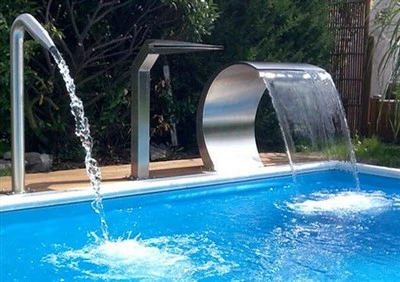
5. Design water features that meet ecological requirements. Integrating the concept of ecology into every water feature design, even if some projects have a large artificial component and it is difficult to see the ecological effect, designers must have this concept. For example, the collection and use of reclaimed water, rainwater and cooling water, the use of fountains to increase oxygen and spray to produce negative ions, and the use of water circulation to construct water fall, turbulence and other landscapes are all beautiful and ecological practices.
6. The unity of garden architecture art and water science. Water landscape is a comprehensive engineering science, especially inseparable from scientific knowledge such as hydraulics, hydrology, and water treatment. From water type and quality, to the design of a nozzle, to the completion of a waterfall surface, there is no lack of profound professional theories.
7. Be aware of water conservation. Every water feature project must have water-saving measures, and designers should consider whether the project requires such a large water surface, how to solve the water source, and how to utilize recycled water.