

Dry fountains for Civil Work Fields
Most dry fountains are installations that belong to the civil-work field. They are usually public projects designed to invigorate and embellish the cities’ common areas, especially squares, parks and gardens. But as our experience in making fountain projects all around China and help our customers in foreign countries, Plaza ground, Modern building gateway, large plublic square also love to make dry fountains either. This means that dry fountains must meet a series of basic requirements aiming to achieve a proper interaction between them and the pedestrians.
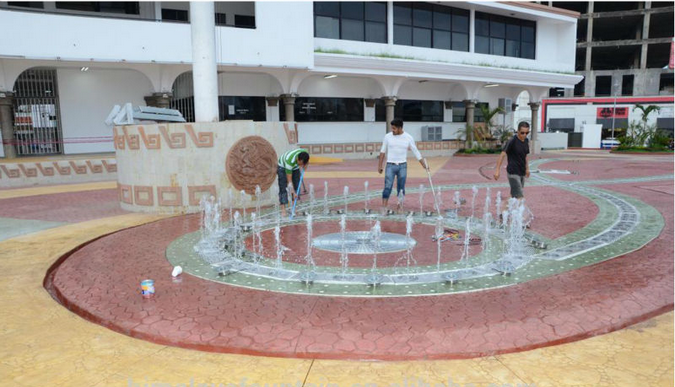
They would be the following suggestions:
Perimeter gutters/gratings must be installed in order to collect the fountain’s water and prevent outer water from entering the dry fountain’s area. The gutters/gratings must be covered by a metal grid – it can be made of cast iron, stainless steel, galvanized steel or any other corrosion-resistant material. When gutters/gratings mostly collect water from the fountain, it is usual that they dewater in the installation’s pits, canals or underground pool. In this case, it is advisable to include a filtering mesh to prevent outer dirt from making contact with the fountain’s water. Gutters that collect outer water (rainwater, irrigation water, cleaning water, etc.) usually dewater directly into the rainwater network and do not need to mount a filtering mesh.
The fountain’s wet areas (the ones containing water: pits, canals, pools and compensation deposits) must be properly waterproofed with the most adequate system or product. Among others, we can choose chlorinated-rubber paints, sheets (PVC or asphalt), etc. The sheets have one disadvantage: they are likely to be torn or pierced if make contact with some of the fountain’s elements (pumps, supporting plates, etc.).
Dry fountains are always connected to an electrical panel(programme or dancing types to choose). The panel can be located outdoors (inside a polyester cabinet) or into a technical room, together with the rest of the fountain’s mechanisms. Be that as it may, it must be placed on a plastered-brick or concrete bench no less than 20cm high. This is a preventive measure that will keep the panel safe in case of flooding.
If the installation of an anemometer is basic in any type of fountain, this is all the more true in dry fountains. The anemometer must always be at least 3-4 meters above the ground, attached to an existent element (street lights, posts…) or to one installed for the purpose. The information about the wind speed and direction obtained by the device will be directly sent to the Control Panel. This panel will manage the fountain’s operation, in order to avoid excessive splashing in the event of strong wind.
The building of an auxiliary compensation deposit is an interesting option for dry fountains. The water flow that feeds the jets is vacuumed from this deposit and returns to it through the corresponding return pipes. This solution is especially recommended for dry fountains with communicated canals; it can also be adapted to other fountain types, though it is not advisable.
Finally, to find a suitable place and choose the suitable and lovely dancing dry fountains are most important. If not make a good design and drawing, the fountains would not be so great and not catch eyes for humans.
Our factory has full set services, please come and contact with us!