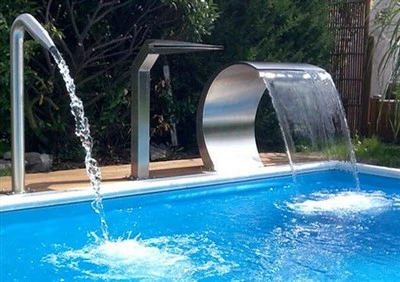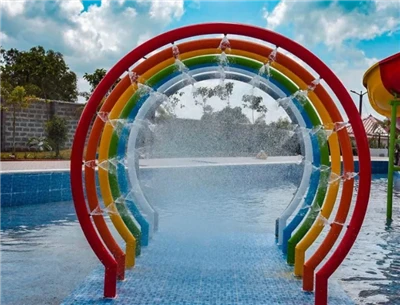


The design and construction of dry pond fountain belongs to a type of fountain water feature design, and different landscape forms are suitable for different application scenarios. For example, music fountains are generally suitable for gathering places such as squares. It is an organic combination of music, water, and lighting that gives people visual and auditory beauty; At the same time, the fountain and the square blend together, forming a part of the building. If it is between buildings in a residential area, it is more suitable to design a stream surround to reflect a peaceful and leisurely atmosphere, giving people a gentle and relaxed visual enjoyment, thus creating a comfortable living space for people.
Projects that choose pipeline materials earlier generally use hot-dip galvanized steel pipes, but there are many shortcomings. After a period of use, the surface of the steel pipe rusts, affecting its appearance, and its service life is more than twice that of concrete structures. The better pipe materials are copper pipes and stainless steel pipes, but the cost is relatively high. UPVC pipes can prevent corrosion, but they have poor weather resistance and accelerated discoloration and aging under direct light irradiation. If it is buried under the bottom plate of the pool (pay attention to the slope and install a vent valve at the lower end when used in the north, and drain and freeze in winter), and copper or stainless steel pipes are used in the exposed part, it should be a more reasonable and economical solution. According to the manufacturer, the service life of UPVC pipes can reach 50 years under conditions without direct sunlight.
The common depth for landscape water pools in civil engineering pool design is 0.6-0.8m. The reason for this practice is to ensure the submergence depth of the water inlet, and the pool bottom is a unified plane, which is also convenient for the installation, construction, and maintenance of pipeline equipment in the pool.
Only when designing shallow butterfly shaped pools that reflect hydrophilic characteristics, suction pits or pump pits are used. There is actually a significant level of insecurity in water depths ranging from 0.6 to 0.8 meters. Similarly, in the design of children's play pools, a depth of about 0.3-0.6m is generally used, and once children fall into the landscape pool, it will be very dangerous. We believe that a suitable water depth of 0.2-0.4m is appropriate. Another advantage of doing this is that when the water quality is slightly turbid, it still gives the feeling of being clear to the bottom. The top surface of the pool wall should be available for visitors to sit and rest. The height of the top surface of the pool wall from the ground is generally 0.30-0.45m. Except for artificial lakes, it is advisable for the water surface to be higher than the ground. If the water level is low, it will feel like being in a deep pool.
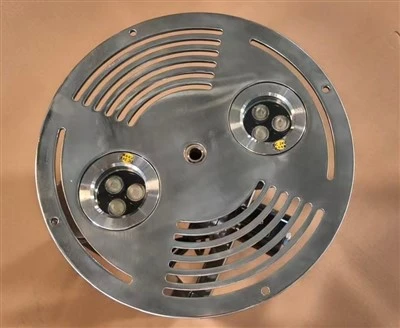
From the perspective of hydrophilicity, a more suitable water spray scale for the design project of a dry pond fountain is 0.2m from the top of the pond wall. Submersible pump pits or pump suction ports only need to be partially deepened to meet the suction conditions. A grate can be set on the surface of the pump pit to maintain a certain degree of concealment of the equipment, and it can also be used as a grille to prevent large particle impurities from being sucked in. From an aesthetic perspective, the surface of the pool should minimize exposed pipeline equipment, especially the vertically arranged overflow pipe openings, which will produce a loud sound of drainage and suction when the water surface rises.